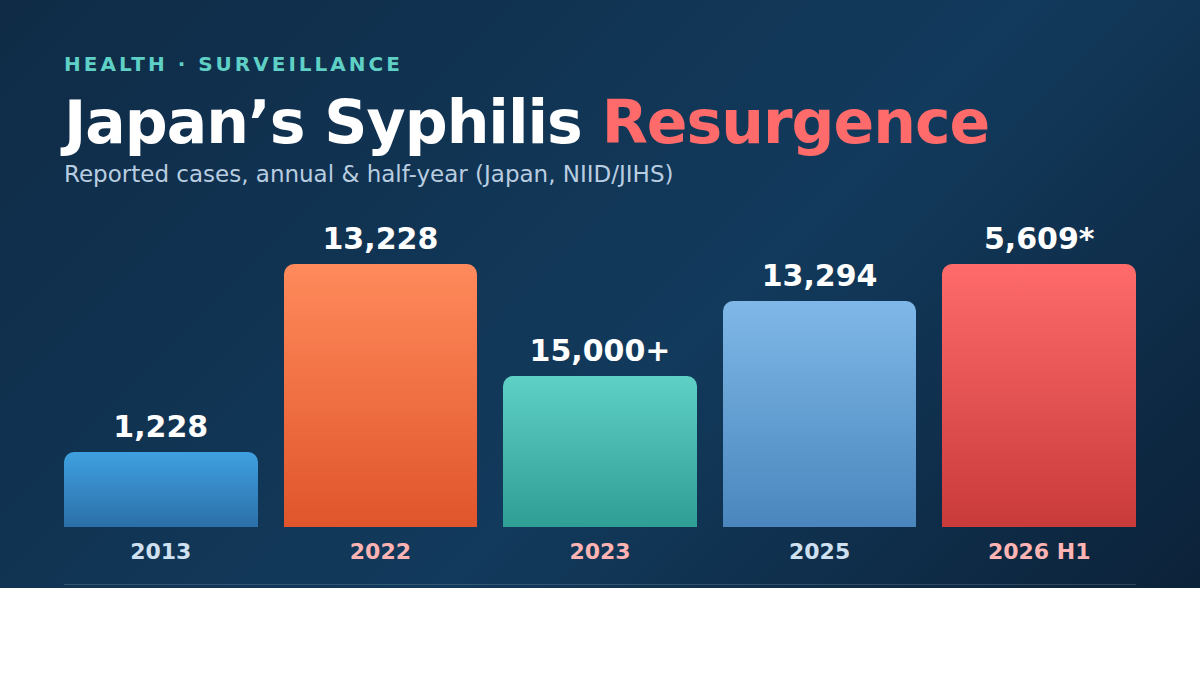
Japan is in the grip of a syphilis resurgence that public-health experts describe as a re-emerging epidemic — one that has been building for a decade and shows no sign of returning to the low levels once thought to be a permanent achievement of modern medicine.
A decade-long climb
In 2013, Japan reported just 1,228 syphilis cases, a figure so small that the disease was widely regarded as a rare curiosity. That changed abruptly. Cases surged past 10,000 in 2022, hit a record of more than 15,000 in 2023 — the highest since the current surveillance method began in 1999 — and have now topped 13,000 for a fourth consecutive year, including 13,294 cases reported in 2025. The latest official data show about 5,609 cases in the first half of 2026. In other words, a disease that had been all but forgotten in Japan now circulates at more than ten times its level of a decade ago.
For context, Japan's 1967 peak under its reporting system was around 11,000 cases, after which the disease declined steadily for decades. The current outbreak has wiped out half a century of progress.
The most recent data. According to the National Institute of Infectious Diseases / Japan Institute for Health Security (NIID/JIHS) quarterly surveillance report, Japan reported 2,660 syphilis cases in the first quarter of 2026 and 2,949 in the second quarter — a first-half total of about 5,609 cases as of July 1, 2026. While the 2026 quarterly figures are somewhat below the extraordinary levels of the previous year (3,748 in 2025 Q2, 3,596 in Q3 and 2,999 in Q4), they remain far above the levels of a decade ago, confirming that Japan's elevated syphilis transmission has become a sustained 'new normal' rather than a passing spike.
Who is being affected
The demographic pattern is striking. About two-thirds of infections are in men, with rising numbers across every age band from their twenties to their sixties. Among women, infections are heavily concentrated in those in their twenties — and the increase has been far steeper. Female cases rose from about 235 in 2013 to more than 5,000 in recent years, a more than twentyfold jump. In Tokyo, one of the hardest-hit areas, male cases rose ninefold over a decade while female cases soared fortyfold.
Geographically, Tokyo accounts for roughly a quarter of all cases, followed by Osaka, Aichi, Fukuoka and Kanagawa — a pattern that tracks the country's largest urban centers.
Why it is happening
Experts point to a combination of social and behavioral factors rather than any single cause:
Dating apps and social media. A study on the association between syphilis incidence and dating-app use in Japan found a significant positive correlation, strongest among women. Analysts say these platforms make it far easier to arrange casual encounters with multiple partners, accelerating transmission through networks that are hard to trace.
The commercial-sex industry. Japan's large and highly developed sex industry is widely cited as a driver. Since 2019, syphilis reports have included questions about sex-industry work and consumption. Among women, 30–40% of reported cases involve a history of work in the industry; among men, the share reporting paid sexual services has climbed steadily, passing 40% at one point in 2022.
Low awareness and stigma. A major obstacle is that many people delay care. Primary syphilis often begins with a painless, inconspicuous sore that is mistaken for an ordinary skin problem; patients frequently seek help only after a full-body rash, joint pain, or even neurological and cardiovascular complications appear. Stigma compounds the delay, and late diagnosis both complicates treatment and increases the risk of unknowing transmission to partners.
A troubling youth culture. In a particularly alarming development, some Japanese teenagers have gathered to show off syphilis rashes on their arms and palms, with a few even faking the marks with makeup — treating infection as a badge of rebellion. The behavior underlines how thoroughly awareness has broken down among some young people.
A treatment crisis on top of an epidemic
Making matters worse, Japan faces a shortage of penicillin, the first-line treatment for syphilis and the only drug recommended for preventing mother-to-child transmission. Production problems at a Pfizer facility have left the Japanese market short, with normal shipments reportedly not expected to resume until the second half of next year. Public-health centers offer free, anonymous testing, and some extend evening, weekend and women-only sessions — yet case numbers remain stubbornly high, suggesting prevention efforts are falling short of the scale of the problem.
Beyond Japan: a global resurgence
Japan's experience is not isolated. Syphilis is rebounding across much of the world after decades of decline:
United States. The CDC reported more than 207,000 syphilis cases in 2022, the highest since 1950. Congenital syphilis — passed from mother to newborn — jumped 937% versus 2018, contributing to 282 stillbirths and infant deaths. In 2025 the CDC issued an urgent letter urging clinicians to prioritize benzathine penicillin for pregnant patients to conserve supply.
Europe. Syphilis cases reached a ten-year high, with more than 45,000 reported in 2024, while congenital syphilis nearly doubled between 2023 and 2024, according to the European Centre for Disease Prevention and Control. The agency has warned of widening gaps in testing and prevention, particularly among women of reproductive age.
Globally. The WHO estimated roughly 12 million new syphilis infections each year, with the Americas and Africa together accounting for more than 70% of the global burden. Rising cases have been linked in many countries to declining condom use, digital platforms facilitating casual sex, and the use of drugs in sexual contexts. Some countries also face shortages of benzathine penicillin, the WHO-recommended treatment.
What other countries — and individuals — can do
Syphilis is curable, and early treatment is highly effective. The lessons from Japan and the wider global surge point to several priorities:
Test early and often. Anyone who has had unprotected sex with a new or multiple partners, or who notices a suspicious sore or rash, should get tested promptly. Testing is often free and confidential, and it protects both the individual and their partners.
Use protection. Correct and consistent condom use remains the single most effective way to prevent syphilis and other sexually transmitted infections.
Screen pregnant women. Because syphilis can cross the placenta, universal and timely prenatal screening — with prompt treatment — is the key to preventing congenital syphilis, which can cause stillbirth, neonatal death and lifelong disability.
Treat partners. Partner notification and treatment break chains of transmission, which is especially important in networks linked to dating apps and commercial sex.
Fight stigma, not patients. Shame-driven silence delays diagnosis and fuels spread. Public-health messaging that normalizes testing, and services that are anonymous and accessible, are essential.
Secure drug supply. The penicillin shortage is a global vulnerability. Governments and manufacturers must protect and expand the supply of benzathine penicillin so that treatment is available wherever it is needed.
Japan's outbreak is a reminder that progress against infectious disease is not permanent. A pathogen that was nearly eliminated by antibiotics can return when prevention, awareness and access to care erode — and the response required is not only medical, but social.





No comments yet. Be the first to share your thoughts.