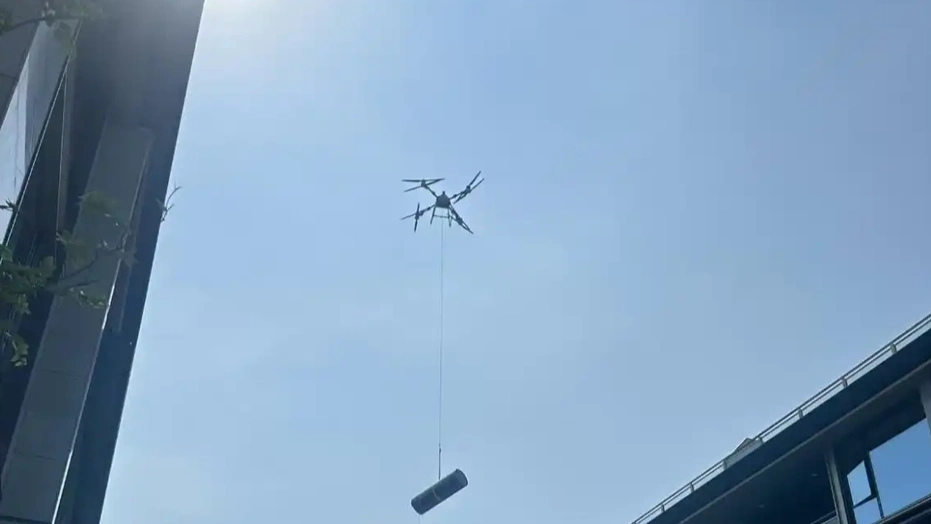
A construction company in Chongqing has drawn public attention after using a drone to lift building materials over an urban area, reigniting debate over the safety of low-altitude cargo flights in densely populated cities — even as drones become an everyday tool across a growing range of Chinese industries.
What happened
Videos posted online showed a drone carrying construction panels at low altitude, with residential buildings and a road immediately adjacent to the lifting site. Netizens questioned the practice, pointing out apparent safety hazards — including footage that appeared to show a panel snapping during the lift, raising fears about what could happen if a load were dropped over pedestrians or traffic.
In response, the Huayuan Road subdistrict office in Chongqing said the flight was a cargo mission applied for and approved through a civil-aviation platform by the construction team. The office added that the transport operation has now concluded, that no safety incident occurred, and that the matter had been reviewed.
The core questions
The episode highlights a tension at the heart of China's drone boom: heavy-lift logistics drones are increasingly used to move materials to sites that cranes or trucks cannot easily reach, but operating them over streets and homes raises questions about load limits, redundancy, flight-path planning, and emergency procedures if cargo is dropped.
Regulators require commercial drone operators to register equipment, hold operator qualifications, and file flight plans, particularly for missions over urban areas or at higher weights. Still, the rapid spread of drones into new uses is outpacing public familiarity with the rules — and public tolerance for incidents in crowded neighborhoods remains low.
Drones are now everywhere in China
The Chongqing case is a small window into a much larger trend. China is the world's largest drone market, and unmanned aircraft are now woven into an extraordinary range of industries:
Logistics and delivery. Drone delivery has moved from pilot programs to regular operations in cities such as Shenzhen, where networks of routes carry everything from takeout meals to medical supplies. In mountainous and remote regions, drones ferry mail, medicine and emergency equipment to villages that roads struggle to reach.
Agriculture. Agricultural drones — mainly for crop spraying and seeding — are one of the largest application categories in China, covering hundreds of millions of mu of farmland each year and dramatically cutting labor and chemical use.
Construction and energy. Beyond the Chongqing case, drones lift materials at difficult sites, survey terrain, and inspect high-voltage power lines, wind turbines and oil and gas infrastructure that would otherwise require dangerous manual climbs.
Public safety and emergency response. Drones are deployed for firefighting reconnaissance, search-and-rescue, flood and earthquake assessment, and crowd monitoring, often reaching areas before ground teams can.
Mapping, media and industry. Surveying, real-estate photography, film and television, and precision mapping now routinely rely on drones, while inspection drones patrol factories, ports and railways.
A strategic industry
Drones are also a strategic economic priority. Chinese manufacturers dominate global consumer and commercial drone production, and the government has promoted a 'low-altitude economy' as a future growth engine — encompassing drone logistics, urban air mobility, and supporting infrastructure such as flight-management systems and vertiports.
The road ahead
For the industry, cases like the one in Chongqing are a reminder that public trust is as important as technical capability. As heavy-lift drones move from remote sites into city neighborhoods, regulators and operators will face growing pressure to tighten flight-path rules, improve cargo-securing standards, and communicate clearly with residents — ensuring that the expansion of drones across China's economy does not come at the cost of safety in the places people live.





No comments yet. Be the first to share your thoughts.