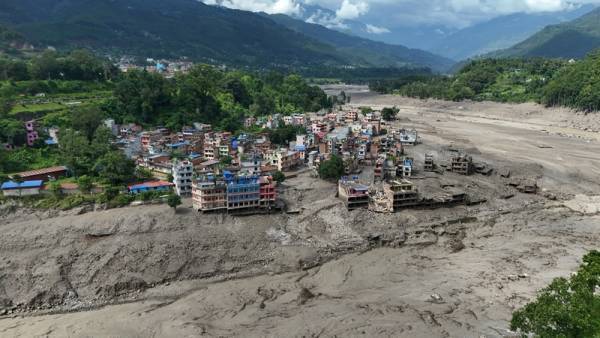
The death toll from a series of flash floods and mudslides that struck Nepal’s northern border region on 26 August has risen to at least 788, according to the latest figures released by Nepal’s police on the evening of 30 August. The disaster hit dozens of settlements along a stretch of the Trishuli River valley near the China–Nepal border, affecting the districts of Rasuwa, Nuwakot and Dhading in Bagmati Province.
Wreckage across three districts
A large wave of mud and debris swept through the area on the morning of 26 August, burying homes, farmland and entire streets. In the hard-hit Bazir town in Rasuwa, buildings stood half-sunk in thick mud, with the Trishuli River, once clear, now running a deep yellow chok full of silt. A yellow bus sat buried in slurry, and a local post office was severely damaged, reporters on the scene said.
In Bidur, a township of around 300 households in Nuwakot where more than a thousand people have lived for generations, a wall of mud sliced through on the same morning. Excavators had cleared a barely passable road, but homes and fields that once sat below street level were entirely filled with sediment, leaving only the upper floors of single-storey shops exposed.
“We don’t know how many are buried”
Residents described a sudden, terrifying surge. “The river rose without warning and swept through the whole area. Everyone was running for their lives. There were so many cars and people scattered in the mud, we don’t know how many are buried,” said a local resident. Another survivor recounted how relatives on a motorbike barely escaped, while several close friends remain unaccounted for.
International rescue effort
Rescue work continues under challenging conditions. Chinese tunnel-rescue specialists have been deployed to Nepal, arriving by helicopter on 29 August and by cargo aircraft on 30 August, to help locate people trapped in tunnels of under-construction power stations along the valley, where heavy sediment has blocked entrances. Experts cited three main difficulties: the risk of further weather and secondary disasters, uncertainty over the condition of those trapped, and blocked access roads.
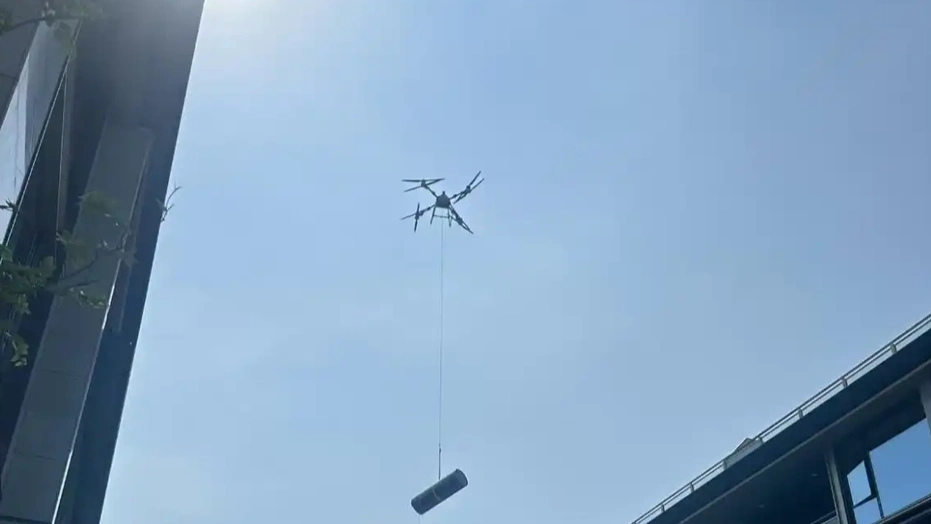
Nepal’s Minister for Science, Technology and Innovation, Mahabir Pun, thanked China for dispatching two aircraft of relief supplies, describing the aid as important for sheltering affected families and supporting reconstruction. Chinese experts said they would first survey the scene and use drones and monitoring equipment to pinpoint trapped people before drawing up targeted rescue plans.
Our thoughts are with all those affected by this tragedy, and with the families of the victims, as rescue and recovery efforts continue.






No comments yet. Be the first to share your thoughts.